Improving Life at the End of the Mesh

The addition of the Topaz MeshCore Node by MeshEnvy introduced MeshCore into the Antelope Valley and Coleville in Mono County California. Before that Node addition, it was crickets down here. The Mesh now covers from the Soldier Meadows area north of Black Rock to Topaz/Coleville in the south: a distance of 210 miles. The issue with this new resource is reaching the last mile with a WisMesh Tag which is a bit hard-of-hearing. I added the Coleville Node to provide more reliable coverage of the Antelope Valley with hand-held or mobile MC systems like the WisMesh Tag. The resulting improvement was on the order of approximately -4dB Tag to Topaz vs. +11.75dB Tag-Coleville-Topaz and beyond.
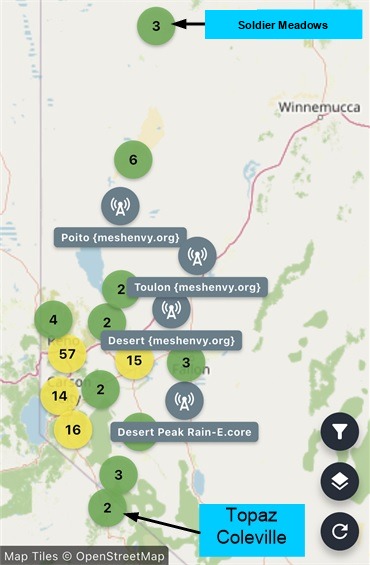
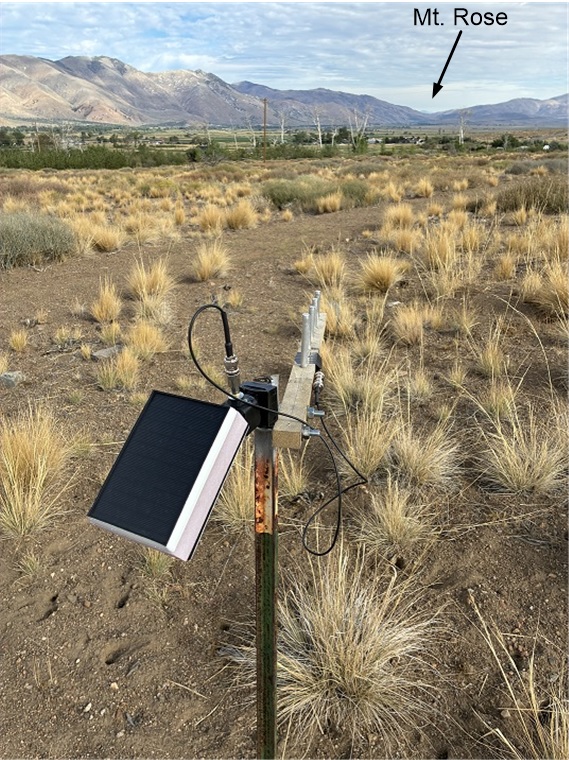
This article describes a home-brew 5-Element Yagi antenna that is installed on the Coleville Node that is pointed toward the Topaz Node, and coincidentally Mt. Rose and the Tamarack Node (through a saddle in the mountains at the north end of the valley). This antenna project should be constructed by interested Mesh enthusiasts.
Construction
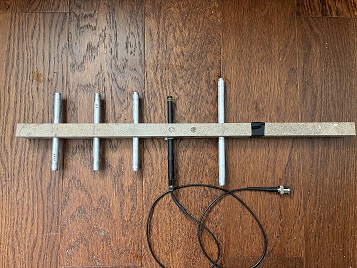
The antenna elements are made from 3/8" aluminum rod available from your local home improvement store. The antenna boom is made (in this case) from scrap Trex decking board but also can be made from wood with some weather treatment. The following table shows the element dimensions in centimeters:
| Element | Length CM | Distance From Reflector CM |
|---|---|---|
| D3 | 12.1 | 26 |
| D2 | 12.2 | 19.7 |
| D1 | 12.4 | 13.7 |
| DE | Linx End Fed 1/2λ (SMA ANT-916-CW-HWR-SMD-ND, R-SMA ANT-916-CW-HWR-RPS-ND) | 8.2 |
| Reflector | 17.1 | 0 |
The most difficult part of the antenna is the driven element. I tried to use a simple dipole antenna and a dipole antenna with a Bazooka current balun. Both attempts proved difficult to construct and therefore duplicate, and the performance was less than sterling. To make the antenna more construction friendly I ended up using a Linx End Fed 1/2λ Vertical Dipole antenna (the part numbers are listed in the table in both SMA and R-SMA connectors).
The final prototype antenna is shown above.
Performance
I used a NanoVNA to evaluate the antenna SWR and radiation pattern.
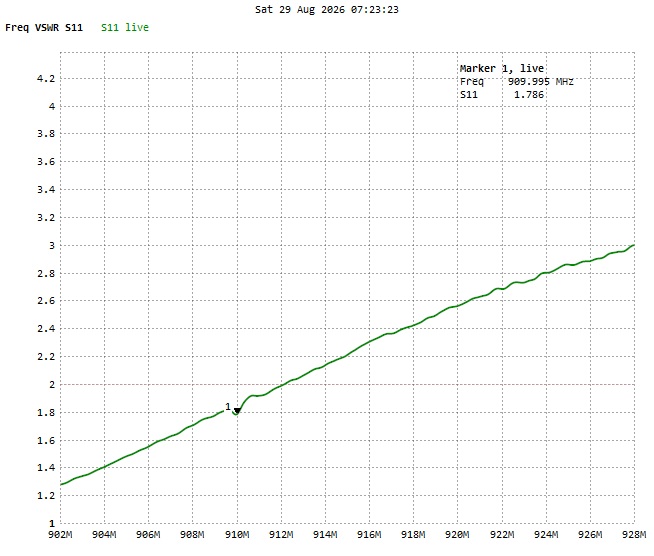
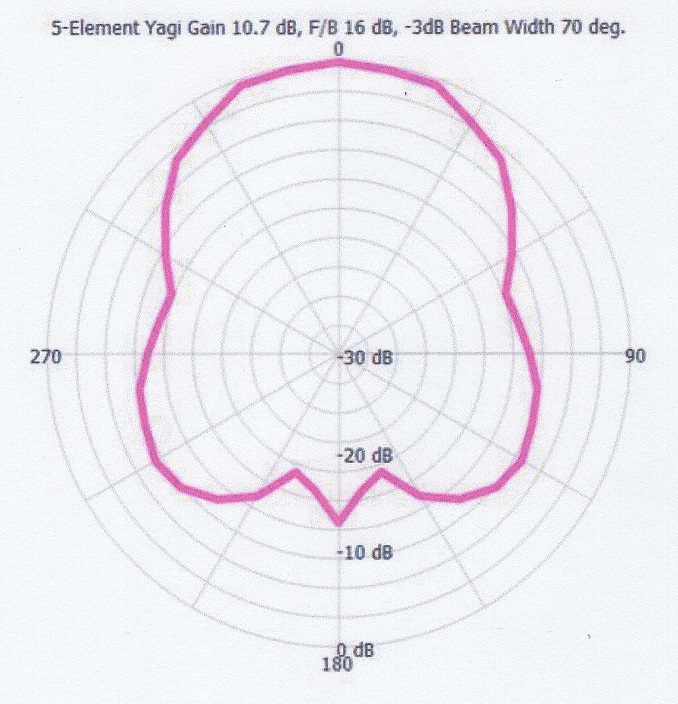
The SWR at 910MHz was 1.8, and the forward gain was estimated at 10.7dB. The antenna pattern appears to be somewhat bulbous, but in this particular situation that is a good thing. The purpose of the Coleville Node was two fold: 1. Improve the connectivity to the Topaz Node and beyond while traversing the valley, and 2. Improving the connectivity of WisMesh Tag like devices and compensated for the lower receiving performance on these devices in fringe areas. The side lobes serve that purpose.
Conclusion
Some readers may find satisfaction in "rolling their own" equipment. Antenna construction is within the means of most users of the Mesh.
Mark Spencer